“The French philosopher Gilles Deleuze (1925–1995) pondered the question: “What holds all this together?” The idea can be simplified as follows: what structures within capitalist social culture enable functional continuity despite its contradictions—or is a shift toward a totalitarian form of society closer than we can comprehend?
In his poetry, the poet Paul Celan (1920–1970) addressed the era following the collapse of European civilization caused by the Second World War. He termed this the “world of stammering.” The world of stammering was characterized by an inability to confront the human and cultural catastrophes wrought by totalitarianism. There were no words for the catastrophe. The era of the stammering world demanded expression, yet the question remained: how could one find a language to articulate it—a language that neither inherits and perpetuates old values nor reinforces an aesthetic rendered hollow, and that is neither deceptively conciliatory or populist nor complicit in forgetting the totalitarian past?
What holds all this together remains a valid question. Is a totalitarian regime embedding itself ever more deeply into European societies? Historically, the rise to power of a totalitarian regime cannot be explained by isolated factors or individual figures alone. The ruthless propaganda of totalitarian movements promises easy solutions to problems stemming from inflation, unemployment, debt, and even military defeats.
Populist rhetoric fosters a sense of national solidarity by vilifying the “immoral” outside world and blaming specific groups for all societal ills. A hallmark of totalitarianism is its appeal to the masses—a collective that, lacking any shared defining characteristic, cannot be equated with any specific class or organization. Totalitarian parties recruit individuals who previously appeared politically passive and became atomized as the class system disintegrated, leaving them feeling insecure about their circumstances. Democratic governance had previously derived its legitimacy precisely from the tacit consent of these passive citizens.
Broadly speaking, according to Deleuze, the point is that the structures of capitalist democracy have been sufficiently diverse to maintain peace and a comfortable life. Now, the world presents itself as a power struggle between various factions over which we have no control. Interpretive perspectives vie with one another for visibility and power.
No one can offer a perfect prediction of how perspectives will be received or interpreted. Given the audience’s complete freedom and right to criticize—as well as its potentially highly heterogeneous composition—it is to be expected that any perspective with even a hint of ethical weight will offend or irritate some people.
The artist’s responsibility is further underscored if we adopt the perspective of the American philosopher John Dewey (1859–1952)—that the issue is not merely the audience’s immediate reactions, but art’s potential to transform the world. Art can be viewed as a significant instrument for shaping society, or at least for fostering ideals—such as compassion and the courage to address injustices—that might otherwise fail to find expression or be put into practice under prevailing conditions.
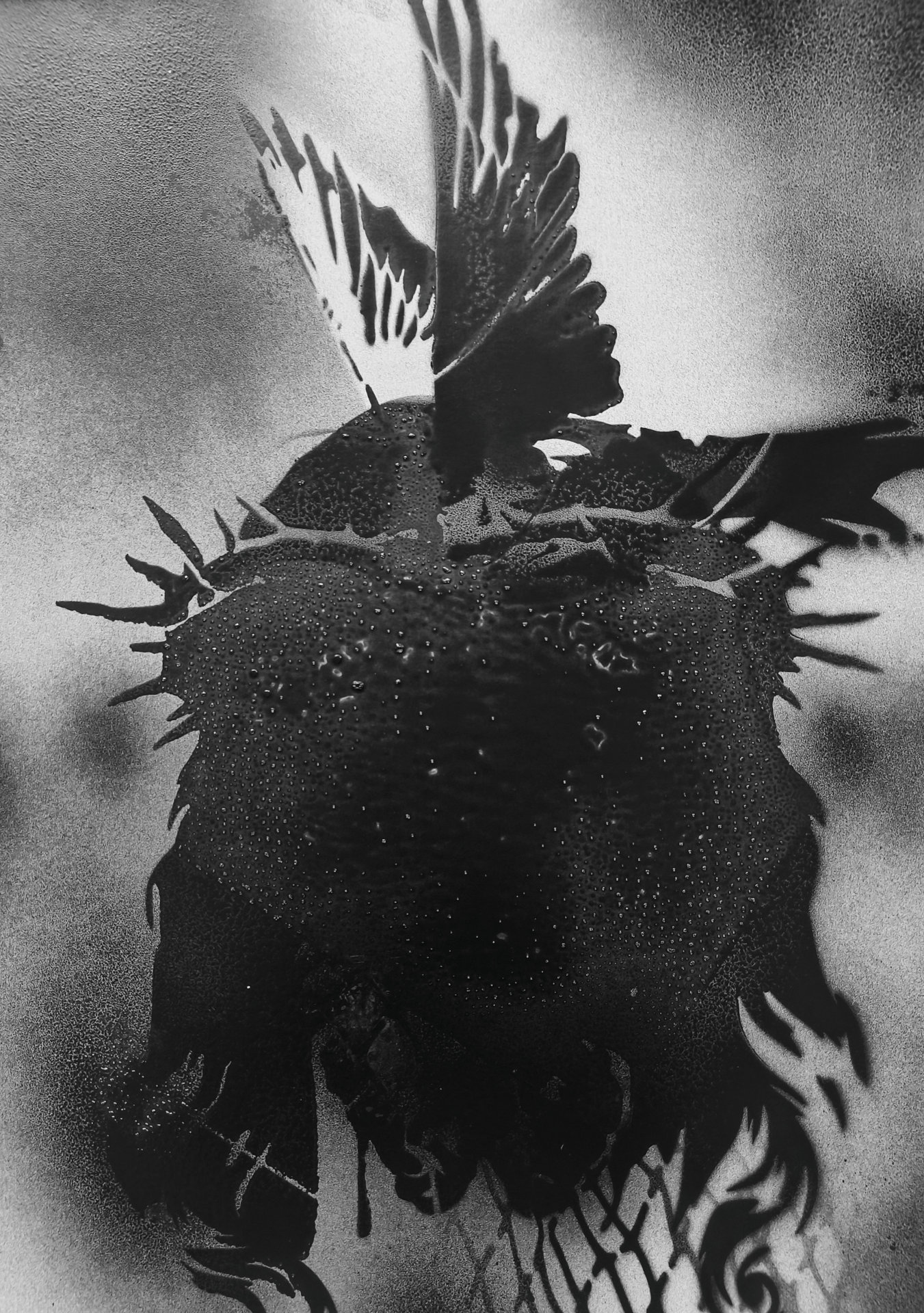
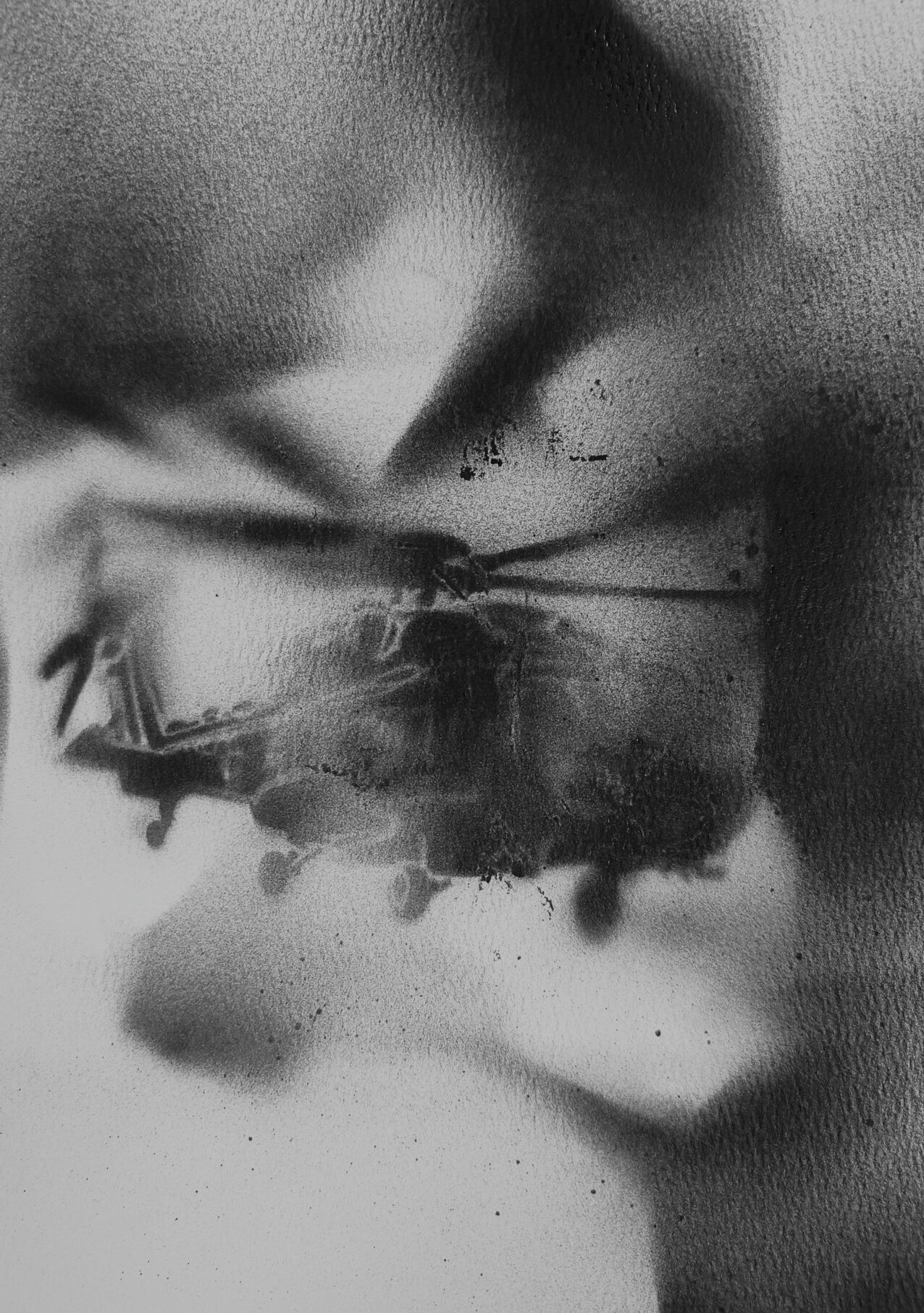
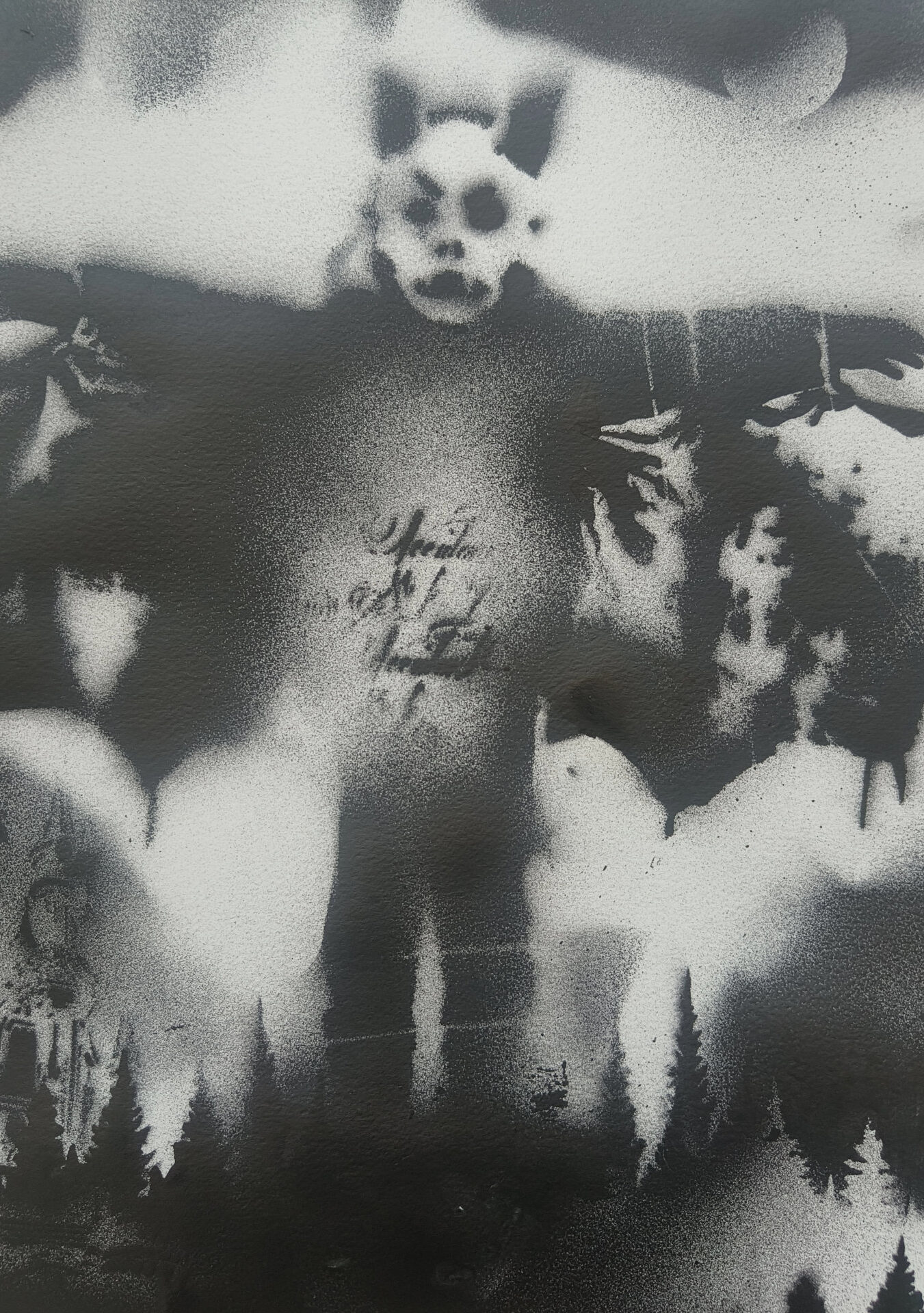
My exhibition at Taidehalli Häme consists of an ink-spray installation in which I explore feelings of anxiety caused by powerlessness—sensations of a stuttering world that is difficult and problematic to comprehend.”
– Dr. Mika Karhu
Mika Karhu (b. 1969) is a Doctor of Arts, visual artist, and researcher best known for his black-and-white drawings and installations. Over the course of his career, he has held more than 30 solo exhibitions in Finland and abroad and participated in numerous group exhibitions. Karhu is a founding member of the artist cooperative Toolbox, which has operated a gallery in Berlin for 14 years. His works are included in various Finnish and international collections.
Karhu has published several peer-reviewed academic articles in the field of artistic research. His latest publication is the essay collection A Stuttering World (2026).